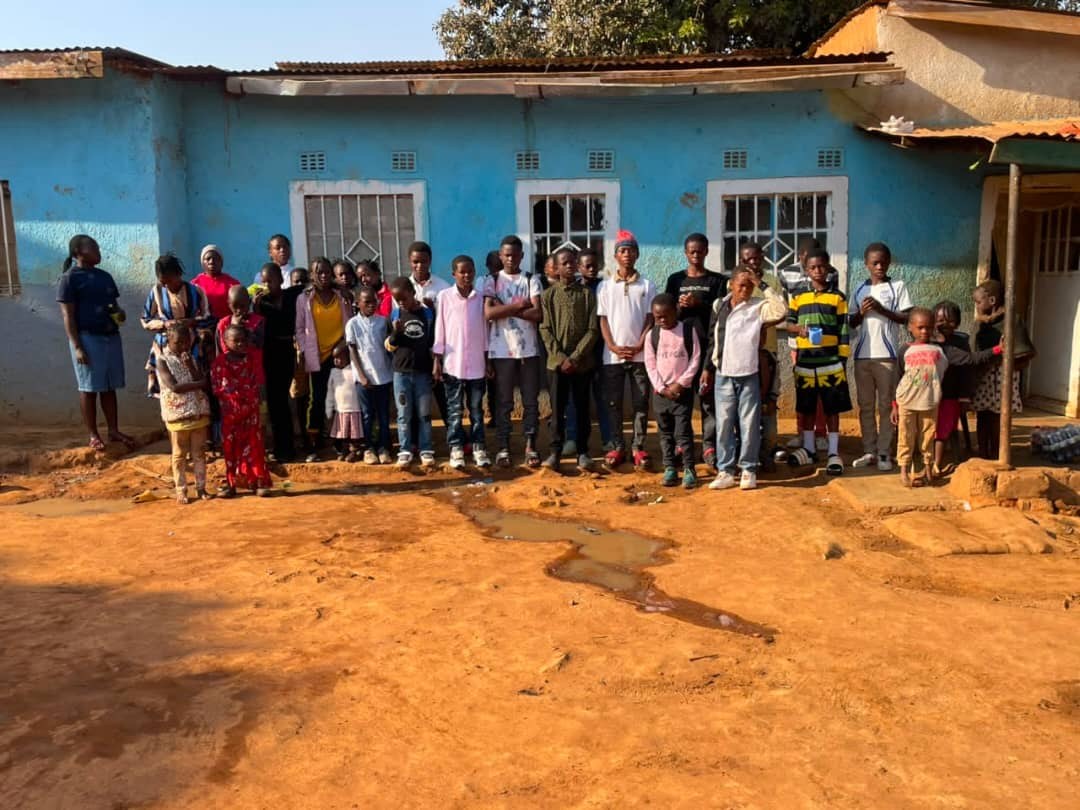
Food on a plate, a school fee paid on time, and basics for a community that has lost everything. Choose an amount, choose where it goes, and give in about a minute.
Give once or every month. Choose an amount, choose where it goes, and you are done in about a minute.
Make your gift
$
Choose where my gift goes
We acceptVisaMastercardAmexApple PayGoogle PayPayPalZeffyMobile Money
Secure checkout. Your card details go straight to Stripe or PayPal, never to us. 501(c)(3) nonprofit, EIN 42-3070865. Your gift is tax-deductible in the U.S.IRS letter
Where your gift goes
Food, education, and humanitarian aid for the DRC
AILE Foundation exists to close the gap between a child's potential and their access to food, school, and safety. Every gift funds three connected areas of work: daily nutrition so a child can concentrate in class, school fees and scholarships so a child can stay enrolled, and humanitarian aid so a family can meet urgent needs during displacement, disease outbreaks, and conflict.
Hunger is what takes a child out of class first
In many homes the family eats once, late in the day. Children leave for school on an empty stomach, or they do not leave at all, because the walk is long and there is nothing to walk on. Teachers see the same thing every term: children sitting in the room, present but too tired to follow the lesson.
Hunger also decides what a family gives up. When the money runs out, the school fee is the first thing to go, and the child who stops eating well is usually the child who stops learning.
A child who eats on school days stays in the room. A child who stays in the room finishes the year.
22%
of the population faces acute food insecurity
Move over a bar to see the number and the source behind it.
When a school closes, a child's whole day empties out
Across the east, classrooms have been shut or turned into shelters for displaced families. The children who used to sit in them are now at home, in a market, or on the road with their parents. Every month out of school makes coming back harder, because the class has moved on and the fee has not gone away.
Girls carry the heavier end of this. When school stops, they are the ones sent to fetch water, to sell, and to look after younger children, and they are the ones most at risk of being married off early.
School is the one place where a child's future is still open. Keeping a seat costs far less than getting one back.
49%
of the children shut out of school are girls
Move over a bar to see the number and the source behind it.
Displacement means starting again with nothing
Families leave in the middle of the night with what they can carry. What comes next is a shared room or a shelter, water that is not safe to drink, and no soap, no mattress, no schoolbooks. Cholera and measles move fast through places like this, and children are the first to fall sick.
Most of the people who need help this year are children. They are living through a crisis they did not cause and cannot understand, and the basics are what stand between a hard year and a lost one.
Clean water, a dignity kit, and a safe place to sleep are not the end of the story. They are what makes the rest of the story possible.
54%
of the people who need aid are children
Move over a bar to see the number and the source behind it.
Sources: UNICEF DRC Humanitarian Action for Children 2026 and the IPC Acute Food Insecurity and Malnutrition Analysis, July 2025 to June 2026.
Where your money goes
What your donation is used for
Every gift is spent inside one of the four pillars we were built on. Food first, because nobody learns hungry. Then school, then the skills and the small businesses that let a young person carry the next family themselves.
01
Food security
Reliable meal distribution to the orphanages and schools we partner with, plus targeted nutrition for infants. It is fundamentally impossible to study on an empty stomach, so this pillar comes first.
Healthy balanced meals, cooked and served where children already are
02
Education
School fees, uniforms, textbooks and materials paid directly to the school, all the way through to full university scholarships. A family's finances should never be the reason a child stops learning.
From primary school materials to full-ride university scholarships
03
Community improvement
Support for local orphanages, and seed capital plus mentorship for young people starting a business. We would rather fund something that keeps earning after we leave than repeat the same handout every year.
Seed grants, mentorship, and support that outlives the gift
04
Leadership
Cultivating moral and practical skills in Congolese youth: mentorship, training, and the kind of guidance that turns a scholarship into someone who goes on to teach, hire and lead at home.
Practical skills and mentorship for the next generation
Our targets for 2026 to 2031
These are goals we are working toward, not results we have already delivered. We will publish what we actually reach as it happens.